



Craft at Speed: How AI-native delivery makes fast and right the same thing
AI-native mode isn't coming. It's already here.
A shift is underway in how digital products get built. The firms that recognize it early are rewriting the rules of engagement.
Jazmin Cabrera, Head of Client Services & Delivery HTEC, shares some thoughts on how we think about it.
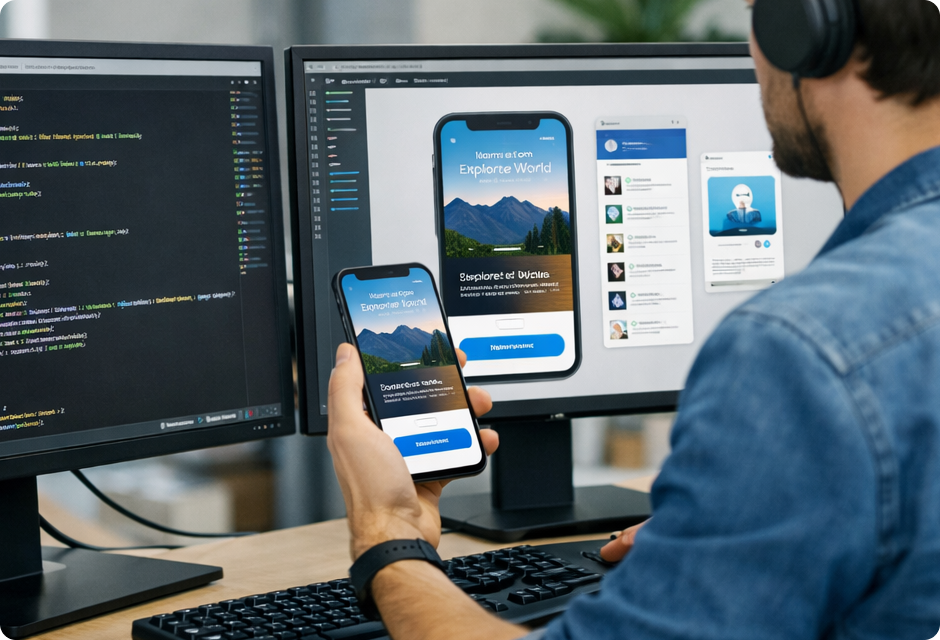
Something has changed in how innovation teams evaluate partners. It happened gradually, then suddenly. The clients sitting across from us are no longer comparing portfolios and delivery timelines the way they used to. They are asking a more direct question: how fast can you show me something real?
The answer used to be measured in months. Today, the market is demanding it in weeks. And the firms that cannot meet that expectation are losing the room before the conversation ever gets to the depth of what they can actually build.
We have been paying close attention to this shift. Across multiple client conversations, RFPs, and post-decision debriefs, a clear pattern has emerged: the definition of "early-stage delivery" has fundamentally changed. Clients are no longer satisfied with a well-reasoned roadmap as the first tangible output. They want executable outcomes. Working software. Something they can put in front of a stakeholder, an investor, or a user by the end of the month.
"Perfect has become the enemy of the good. And in the race to get it right, many teams have been losing to teams that simply ship."
This is the reality that shaped how we think and operate at HTEC Momentum. We did not arrive here theoretically. We arrived here through honest reflection on where the market was moving, what clients were actually asking for, and what it would take to lead rather than follow.
Three modes of delivery. One conversation that changes everything.
What we have learned is that most clients are not asking for the same thing, even when they use the same words. The critical unlock is understanding which mode they are actually in before a single line of scope is written.
Mode 01
Rapid validation
Prove the idea with working code. Outcomes in weeks. The bar is viability, not polish. Move fast and learn faster.
Mode 02
Production build
Build it right, build it to last. Scalable architecture, considered design, and long-term product thinking from day one.
Mode 03
Phased acceleration
Start with a rapid proof-of-concept, then evolve deliberately into a production-grade system. Speed and quality, sequenced correctly.
Meeting clients where they’re at with the right mode of delivery
The mistake many teams make is leading with a large, open-ended engagement before the client is ready for it. When a team needs to validate an idea, unlock funding, or get internal alignment, the most valuable thing a partner can offer is not a months-long build — it is a fast, structured discovery or feasibility assessment. Something that answers the most important question quickly: is this worth pursuing, and what does pursuing it actually look like?
That kind of immediate, tangible output changes the dynamic entirely. It meets clients where they actually are, rather than where a traditional engagement model assumes they should be. And it creates the trust and shared understanding that makes everything that comes after it go faster.
Our process now starts with a different set of questions. What does this team actually need to move forward, and by when? Are they validating, scaling, or bridging both? That single clarification changes everything about how we scope, staff, and sequence the work.
AI-native delivery is not a trend. It is the new normal.
The teams winning these early-stage deals are not doing it with larger headcounts or more generous timelines. They are doing it by embedding AI tooling directly into their delivery workflow. Code generation, rapid prototyping, iterative testing — the SDLC itself has been restructured around AI assistance, and the result is a fundamentally different speed-to-outcome ratio.
Here is the mechanism that makes this possible. AI handles the scaffolding: the boilerplate, the repetitive structure, the iteration cycles that used to consume the majority of a team's time and cognitive load. That compression is what gives teams the space to apply craft where it actually matters: the decisions that shape user experience, the architectural choices that determine long-term scalability, the design thinking that turns a working prototype into something people actually want to use. Speed and craft stop competing because they are no longer drawing from the same resource pool. AI absorbs the volume. Humans direct the judgment.
What makes HTEC Momentum different
At HTEC Momentum, this is how we now operate across all three delivery modes. Our AI-SDLC framework is not a bolt-on offering or a slide in a pitch deck. It is the underlying methodology that allows us to compress timelines without compromising the design and engineering quality that has always defined our work.
We also believe in being transparent about what this shift requires. Moving faster with AI-assisted delivery means managing new operational realities: token usage and cost governance across tools, team enablement and workflow fluency, and maintaining quality standards at speeds that would previously have been impossible.
These are not barriers. They are disciplines. And having navigated them across real engagements, we are in a position to bring that operational maturity to every client we work with.
Why delivery mode is the most important question to ask
If you are leading product, engineering, or innovation at an organization evaluating a new build or trying to move faster on an existing one, the most valuable conversation you can have right now is not about features or timelines. It is about mode.
What does success look like in four weeks versus four months? What is the cost of waiting to get it perfect before showing it to anyone? And who on your current roster can actually deliver both the speed and the substance your stakeholders are expecting?
Those are the questions we now start every engagement with. And they are the reason our clients are shipping proof — not just plans.
HTEC Momentum is the design and product business unit of HTEC Group, working with enterprise and growth-stage clients across North America and Europe on AI-native product development, design systems, and digital transformation.


Download this white paper
Complete the form below to download your copy of the report and find out how to accelerate growth through extraordinary customer experience.


Let’s partner to move your business forward.
Leave your details and we’ll get back to you.
Looking to join our team?
Visit our Careers page